

(English) Thayland Phuket
2025
It’s mid-December 2025, and it’s starting to rain and get cold in Istanbul. We’re going to Phuket, one of the world’s largest islands, south of Thailand. Although it’s considered an island, it’s connected to the mainland by a bridge. After a long journey, we arrived at our hotel in the evening. Suitcases in the room, us to the sea. The hotel is right on the beach, 15 steps from the sea; the sandy beach and the sea are truly wonderful.
We watched the sunset, and it started to get dark. Preparations were underway on the beach; tables and chairs, the entire beach was a restaurant. All the food was prepared in mobile kitchens no larger than 5 square meters, which were moved to another location at night and brought back to the same place in the morning. Their menus, mostly seafood, have more than 40 different dishes, and in such a small space, they prepare whatever you want in 15 minutes. They are all beautiful and delicious. Around 10 PM, they slowly start packing up; within an hour, everything is spotless, the kitchen, tables, chairs, everything is gone. It’s like a joke, a shantytown restaurant.
Our hotel is a boutique hotel in Nai Yang, a coastal town on the northwest of Phuket Island, named after the bay where it’s located. Nai Yang is peaceful, quiet, and its economy is based on tourism. About an hour from Phuket city center and 15 minutes from Phuket International Airport, it’s a beautiful town with its azure sea and wide beaches, especially for those who want to relax, get away from the crowds, and be alone with nature. The people are warm and hospitable, friendly, and try their best with their broken English. The beach transforms into small restaurants every evening, usually with seafood-heavy menus. If you don’t have a specific reason for going to Thailand, Nai Yang, with its simple and natural atmosphere, is a wonderful place to escape the bustling city life, unwind, and calm down. After a few days, the worries about what day of the month it is, what day of the week it is, and what the day’s schedule is like, disappear; every day is like Sunday. It’s nice to live like this; no worries, anxieties, or stress about politics, the economy, the future, or the state of the country. Live in the moment, don’t worry about anything, living a carefree life has truly felt good. It seems I needed something like this, especially with good friends. Returning home, readjusting to the state of the country and the world won’t be easy. Don’t let that sound fool you; breaking free from love for one’s homeland isn’t easy.
**
Thailand, officially the Kingdom of Thailand, is one of the most visited countries in Southeast Asia. Its capital is Bangkok, and it covers an area of approximately 513,000 km² with a population of over 70 million. Thailand has a tropical climate with hot and humid weather year-round, an economy dominated by tourism, agriculture, and the service sector, and a cuisine famous for its rice, seafood, and spicy dishes.
The royal family is highly respected and considered a symbol of national unity. Thailand appeals to both nature and cultural tourism with its lush tropical forests, magnificent islands, and vibrant city life. Approximately 93% of the Thai population is Buddhist. Muslims make up about 5% of the population nationwide, and are more concentrated in the southern regions, particularly around Phuket. Christians, Hindus, and other religious groups make up about 2% of the total. On Phuket island, Buddhism is the dominant religion, with an estimated 20-30% of the population being Muslim. Christians are fewer in number. Regarding Nai Yang, I noticed that most of the women wear headscarves; it seems the Muslim population is somewhat larger there. Women are involved in the workforce, and there’s absolutely no bigotry or prejudice; everyone you ask is helpful. Taking photographs of women in Muslim countries is very difficult, especially in the Middle East. I’ve experienced such situations in the past, so I know.
Since there were so many Muslims, we started looking for a mosque, thinking there must be one in the whole place: Darul Abiden Mosque. It didn’t seem to have many customers except on special occasions. The exterior of Darul Abiden Mosque, with its small domes, square, not very tall minarets with small domes on top, differs from Middle Eastern and Turkish Islamic culture. Inside, the floors are marble, there are many pillars, and there are no signs or symbols indicating that it’s a sacred place or a holy site. If you went in with your eyes closed, you might think it was a wedding hall. At first, I felt a little uneasy, wondering if we were in the wrong place, but that’s how it was. There was something like a small pulpit on one side, probably where the imam led prayers, so the qibla must have been. There was only a small pulpit-like structure with a verse on it, which was only noticeable upon closer inspection. Anyway, we went outside hoping everyone’s prayers would be accepted. It was Saturday, tables were set up, and people were eating from a buffet-like area. The imam greeted us; after some initial welcome and introductions, his interest increased when he learned we were from Turkey. He was exactly the kind of person I was looking for; he talked, he explained, everything was fine. First, he insisted we eat, stating that everything was halal, and the people around us were genuinely hospitable and wanted to offer us something. Our stomachs were full; we wished we hadn’t eaten, but we did eat a little bit. Every weekend, for the sake of God, poor people, regardless of their religion, come here to eat or take food home. It’s wonderful how people want to take pictures; they don’t shy away, they even pose for the pictures we want. There were dozens of children’s shoes at the top of the stairs; we were curious, and he said, “Come, let me show you,” so we went upstairs together. In two different classrooms, elementary school-level children, who have regular school during the week, are given lessons about the Quran and Islam every weekend. It’s very good for the continuation of their culture, and the financial resources are entirely from donations within their social circle and community. Compared to similar schools I’ve seen in other parts of the world, it’s a clean and tidy place. Nai Yang is actually a small bay, with a long sandy beach, and national parks at both ends, all under protection. Walking from one end to the other in the mornings is delightful, and if you do it in the evening at sunset, the beach is transformed into a restaurant with tables and chairs when you return. Today was all sea and sun, a real treat, but we got very tired! Evening massage time is both wonderful and very cheap; we’ll continue whenever we get the chance. Today we’re going to Phuket for a city tour, to see what has changed since our last visit. On our way, we’ll pass Wat Chalong Buddhist Temple, one of the must-see places. Wat Chalong is known as Phuket’s largest, most important, and most beautiful Buddhist temple. This complex, frequently visited by locals and tourists, is particularly notable for its large pagoda, or tower-shaped temple. It is believed that a sacred relic of Buddha is kept inside the pagoda. The temple is not only for religious worship but also a center for social events and charitable activities for the local people. Wat Chalong is one of the important temples that symbolizes Thailand’s cultural and spiritual richness with its impressive architecture, peaceful and mystical atmosphere.
If you suddenly hear a series of explosions here, stay calm. If you go to where the explosions are happening, you’ll see that in a closed, secure room, explosives bought with money are being detonated in a chain reaction. Depending on your sins, the more sins you have, the more explosives you need to buy and detonate. Then, all your sins are zero. Back to your dark life! It hasn’t been discussed in a while, but it used to be said all the time. In Islam, they used to say that if you go to Friday prayers and donate to the mosque, all your sins will be forgiven. I took out my life inventory, checked my situation, added, divided, subtracted, reviewed my actions, thought about my good deeds and sins, and said, “I’m clean, there’s no need to detonate.” Then I ordered myself an ice-cold beer, said “Well done,” and drank to my health. There was a long, continuous series of explosions. Wow, I thought, they must have a lot of sins.
Continuing on, we stop at a shopping mall called Central Phuket for a short break. However, the break lasted more than a few hours; we went in for a restroom break and came out with our arms full of bags. I had understood the restroom break as a bathroom break, but nobody else went to the restroom except me. I realized that going to the shopping mall for a restroom break was a strategic mistake, but it was too late. We continued on our way and arrived at Phuket’s old historical city center.
Phuket Old Town, the historical city center of Phuket, is one of the areas that most vividly reflects the island’s cultural fabric. With its colorful Sino-Portuguese style buildings, narrow streets, and historical structures, it carries the traces of the past into the present. The city, which prospered from the tin trade in the 19th century, was shaped by the colonial architecture of that period; pastel-colored facades, wooden shutters, and ornate balconies have been preserved as part of its historical texture to this day. In the evenings, it’s a lively place with live music, exhibitions, and cafes in the streets. A market is held on Sundays, so you can find many things unique to the area, especially street food. For seafood lovers, it’s really good and cheap. There’s even a Turkish restaurant, a kebab shop. You can also find all kinds of tropical fruits and vegetables unique to this area. As evening falls, street musicians emerge, creating a delightful spectacle. We came here on Sunday to experience all of this together. Phuket Old Town is a delightful place worth seeing, with its architecture preserving the traces of the past and its vibrant events reflecting the energy of today.
Let’s briefly learn about Phuket; what is it like?
Phuket is located in Southeast Asia, on the southwest coast of Thailand. With a total area of 576 square kilometers, it is 860 kilometers south of Bangkok and 830 kilometers north of the equator. It is Thailand’s largest island and the country’s second smallest province. Situated in southern Thailand on the Andaman Sea coast, 70% of Phuket is mountainous, with a long mountain range stretching 440 kilometers from north to south. Phuket Island, formerly known as Thalang, meaning “hill” in Malay, was devastated by a tsunami following an earthquake in the Indian Ocean in 2004, but quickly recovered and became one of the world’s most famous holiday destinations.
One of Thailand’s largest cities, Phuket is a world-renowned tourist destination that attracts millions of foreign tourists every year. It boasts lush greenery, rich vegetation, forests, numerous temples, and entertainment areas.
The island, which gained further fame thanks to Leonardo DiCaprio’s film “The Beach,” is most visited by visitors for its magnificent 45-meter-tall Big Buddha statue made of marble on Chalong Hill.
Offering every kind of water sport, Phuket and its surrounding 32 smaller islands are home to some of the world’s best scuba diving spots.
Phuket was a major tin producer since the 16th century, and after becoming the country’s tin production center in 1910, it shifted towards rubber production and tourism. The beaches on the west have been developed since the 1980s with popular destinations like Patong and Karon, making the island a global tourist hub.
Phuket is home to over 415,000 people, the majority of whom are ethnic Thai Buddhists. There are also Muslims, mostly of Malay descent, Chinese, and a small number of Sea Gypsies, who are the island’s original inhabitants. Like the rest of Thailand, the people of Phuket are friendly and hospitable.
The average year-round temperature in Phuket ranges from 21 to 34 degrees Celsius, making it a popular destination at any time.
Phuket’s economy is largely based on tourism. The dynamism brought by tourism allows the island’s inhabitants to earn a living working in hotels, restaurants, transportation, and various service sectors. In recent years, agriculture, fishing, and pearl production have become significant parts of the local economy. Life in Phuket unfolds at a calm and peaceful pace, influenced by the tropical climate. The locals preserve traditional Thai culture while also enjoying the conveniences of modern life. This balance plays a significant role in creating the island’s unique atmosphere. The most amusing word here is “555,” pronounced with a “Hahaha.”
I don’t know what day it is, but today I’m on a leisurely get-together. Afterwards, I rewarded myself with a full-body massage, as I couldn’t possibly handle all the tiredness.
Within walking distance is a public market where people do their shopping. The markets are very colorful and are important landmarks reflecting the region’s culture. You’ll see different people at different times of day; towards evening, mostly workers, those hoping to find cheaper goods late at night, and those of moderate means during the day. Because of the Muslim population, some stalls selling meat and dairy products have signs that say “halal slaughter.” I asked someone I spotted what halal slaughter was, wondering what they would explain. I didn’t fully understand, but I think they explained it correctly.
**
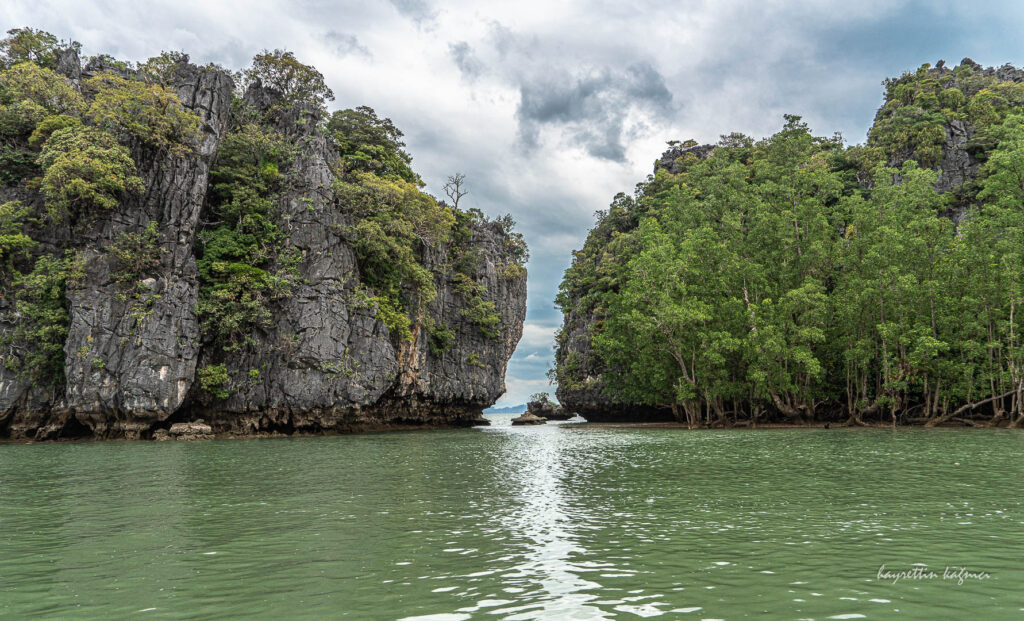
One of the must-see places when you come here is Koh Panyee, the “Muslim Village” built on stilts in the sea.
Koh Panyee, also known as Koh Panyee, is a fishing village in Thailand’s Phang Nga province, built on stilts in the middle of the sea by Javanese fishermen. Thanks to its geographical location, Koh Panyee is protected from tides and tsunami risks. It is a floating island consisting of approximately 360 families, or 1,600 people, descended from two Muslim seafaring families who came from Indonesia 200 years ago. In other words, everyone here is related to each other. The island, which has grown over time with wooden additions on stilts, also has facilities such as a mosque, a school, and a football field.
In the late 18th century, because land ownership was not granted to non-Thais, this settlement was built on stilts by nomadic Javanese fishermen under the protection of the bay. With the rise of the tourism sector in Thailand and the resulting increase in societal well-being, land purchases on the island became possible, leading to the construction of a mosque and a freshwater well on the shore. The village has an unofficial primary school for children, but due to the hardships of life, the younger generation prefers to migrate to more affordable places. Because there is no agriculture or production, almost all necessities are brought in from the mainland by boat. The floating Kod Panayi village also has a football field where young people play matches. The villagers mainly make their living from fishing and tourism.
The village, which expands on stilts as needed, has stalls in front of its houses selling souvenirs. Among the narrow walkways and ramshackle houses, there are some decent, noteworthy structures; I peeked into one and everything seemed fine. It seems the bigwigs, the barons, live here. This world is unchanging, it’s the same everywhere!
After a while you get lost, but that’s the charm of it; no matter which way you go, you eventually end up in the same place. I set out in search of the mosque, I could see the minaret but couldn’t reach it, finally I found it right at prayer time, great, the imam’s staff was there. I talked to the imam, a brief explanation, but he was also complaining that people weren’t coming, meaning the mosque had no customers. It’s not very small, I estimate it would only hold 100-150 people if it were full, but there were only seven people praying.
There’s a huge restaurant, clearly large groups come here. Apparently, the restaurant owner must be one of the bigwigs around here, otherwise there wouldn’t be a place like that right at the entrance.
I’m going to the Buddhist temple opposite the Nai Yang public market.
It’s not very obvious from the outside, but it’s a large complex, the Vat Monkol Wararan Buddhist Temple. A large temple that stands out both for its architecture and its spiritual atmosphere, the main building is designed from original examples of traditional Thai architecture, and the large courtyard at the entrance gives visitors a peaceful and spiritual feeling. The temple is an important center for the religious rituals and festivals of the Buddhist community in the region, as well as a frequently visited sanctuary by locals and tourists. The morning ceremonies and the monks walking around the temple allow visitors to experience the depths of Thai culture firsthand. Inside the temple, gold-leafed Buddha statues and meticulously designed decorations, along with Buddhist teachings and culturally significant motifs of the Thai people on the walls and columns, are noteworthy. Visitors can meditate, pray, and perform their religious duties as needed. This temple in Nai Yang offers both a spiritual stop and a cultural richness, reflecting the spirit of Phuket in a unique way.
I spend some time here, taking photos and chatting with the Buddhist staff and monks. Every temple, every shrine, every belief is sacred and beautiful, and tells the truth.
After our enjoyable conversations without any time control, I realized I was tired as darkness began to fall and had the longest package, a massage. They really know what they’re doing, and it’s very relaxing. The time has come, it’s time to go back, just as every beautiful thing has an end. With love,
Hayrettin Kağnıcı
December 2025